Jacaranda mimosifolia
12 February 2026
- Common name: Jacaranda
- Scientific name: Jacaranda mimosifolia D. Don, 1822
- Honoris Causa: Ramón Lobo Leyder (01/28/2020)
ORIGIN: South America.
CHARACTERISTICS:
- An excellent tree for gardens, planted in rows or as a specimen tree.
- Late deciduous or semi-evergreen.
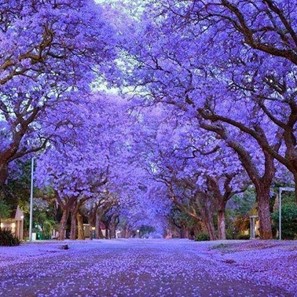
- The flowers are very beautiful, bluish or purple, bell-shaped, and large (approximately 10 cm). The flowers first appear in April-May, then fall, leaving the tree bare or semi-bare, and the leaves emerge later.
INTERESTING FACTS:
- The song by María Elena Walsh goes like this: “To the east and to the west/it rains and will rain/one flower and another sky-blue flower/of the jacaranda.” Jacaranda in Guarani means “hardwood.”
- The “mimosifolia” refers to the mimosa tree because their leaves are very similar.
USES:
- ORNAMENTAL: A tree of great beauty and hardiness.
- FORESTRY: Its wood is used to make furniture, paneling, etc., due to its ease of working and good quality.
- DECORATION: Its castanet-shaped fruits are used to make keychains, coin purses, earrings, etc.
Jacaranda mimosifolia D. Don is a species native to Argentina, Bolivia, and Paraguay, commonly known as Jacaranda or Lilac Tree.
The genus name Jacaranda is the Latinization of the indigenous name for these plants in the Tupi-Guarani language of the Amazonian tribes. The specific epithet refers to the morphology of its leaves, which resemble those of the mimosa tree.
It is a tree, sometimes shrubby, semi-evergreen, 8–20 m tall, reaching up to 30 m in its native region, with an erect trunk and robust branches. The leaves are elegant, glossy green, up to 45 cm long, compound, bipinnate, with imparipinnate pinnae formed by numerous pairs (13-41) of sessile leaflets with mucronate apices, ovate-lanceolate, elliptic, or oblong-elliptic, 3-12 × 1-4 mm, 25 × 7 mm at the terminal end. They remain on the plant until December-January.
The leaves, up to 45 cm long, are compound, bipinnate, and a beautiful glossy green. The inflorescences, in dense terminal panicles, measure up to 16 cm.
The flowers, blue-violet, are hermaphroditic, zygomorphic, pedicellate, and pentamerous. They are grouped in erect terminal panicles, up to 16 cm long. The calyx is gamosepalous, campanulate, 3–4 mm long, with teeth ± 1 mm long. The corolla is gamopetalous, tubular-ventricose, bilabiate, with a trilobed upper lip and a bilobed lower lip. There are four free stamens. As in other species of the genus *Jacaranda*, the flower has a hairy staminode larger than the other stamens (3–3.5 cm long). The gynoecium is syncarpous with a superior, bicarpellate, and bilocular ovary.
The fruits are large, woody, globose-ovoid capsules, 3.2–6 × 3.7–6 cm, compressed, with wavy margins, and dehiscent. They ripen in autumn and winter and persist on the plant for a long time. They are leather-colored and contain numerous winged seeds measuring 9–17 × 11–17 mm.
J. mimosifolia is a plant that is quite sensitive to cold, growing outdoors only in regions with a temperate climate and tolerating temperatures near 0 °C only for brief periods. It prefers sunny locations with well-drained soil.