Presentation of the report “Economic and social contributions of the Valencian Public Universities”
Rector's News , Other events, Presentations
2 March 2026
University rectors call for the use of human and technological assets to transform the Valencian Community’s production model
Monday, February 4, 2013
The report on the Social and Economic Contributions of Valencian Universities, presented this morning in Valencia, reveals that Valencian society receives €1.90 for every euro invested in the public university system; that all Valencian universities have doubled their scientific output since 2002 and are above the Spanish average in publications and patents; and that the number of university graduates working in Valencian companies has almost tripled in less than two decades.
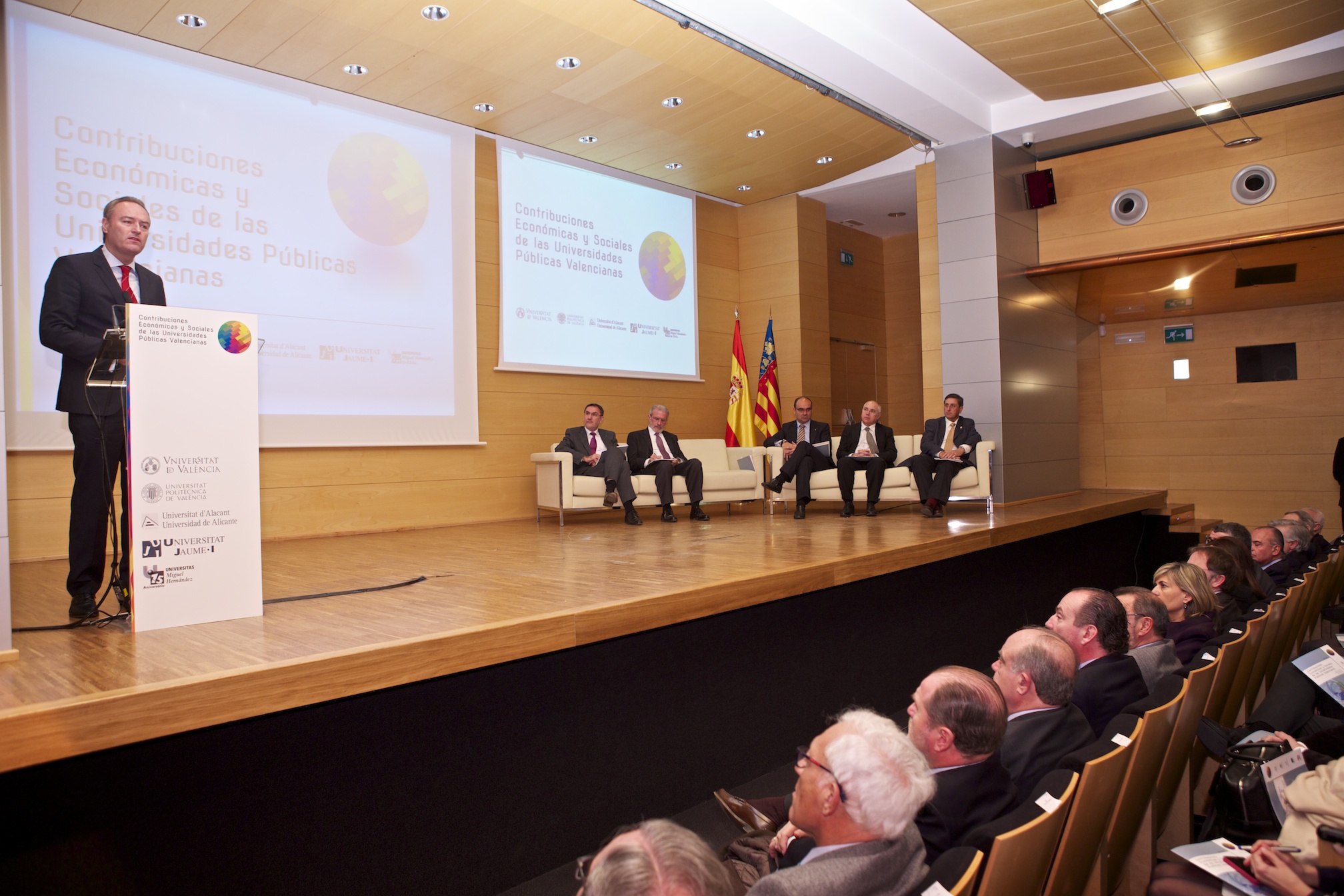
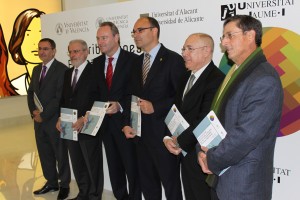
During the event, which was attended by the five rectors of the Valencian public universities and the President of the Generalitat, Alberto Fabra, it was noted that, despite the crisis, “the number of university graduates employed in the Valencian Community has increased by 8.4%, now representing 26.1% of the employed population. Nevertheless, the university unemployment rate reaches 14.7%, and the percentage of graduates overqualified for their jobs is 28%.”
The report, prepared by the Institute of Economic Research (IVIE), reveals that the tax return obtained by the public sector in funding Valencian university education is more than positive: 10.6% for bachelor’s degrees and 5.9% for associate’s degrees. However, it also highlights that enrollment figures have not changed substantially in the last four years. Among the non-quantifiable economic factors, Francisco Pérez, director of the IVIE (Valencian Institute of Economic Research), commented that the Valencian Community’s public universities “also make significant contributions in areas that go beyond the strictly economic.” Some examples include the positive impact of university education on healthy lifestyles, social and political participation, and its role in mitigating inequalities between men and women in the workplace.
In this regard, the president of the Conference of Rectors of Valencian Public Universities and rector of the University of Alicante, Manuel Palomar, stated that “we are aware that our contributions to society and the economy make us one of the cornerstones of economic development and the well-being of Valencian society, and one of the main strengths upon which it can rely for its transformation.”
For his part, the President of the Generalitat, Alberto Fabra, emphasized that universities are “the engine of growth and the foundation of productivity and competitiveness,” and therefore called for “more effort than ever before to channel the talent of our graduates to improve productivity and employability.”
Relations with the Environment
Among the weaknesses that must be addressed, Pérez pointed out, the shortcomings in technology transfer stand out, “a key aspect for assuming a more prominent role in the advancement of Valencian society and the economy.” Considering the characteristics of the Valencian Community, it is clear that its per capita income and productivity levels are significantly below the Spanish and European averages, reflecting a decline in its capacity to generate added value and compete at all levels.
The trajectory of the Valencian economy over the last decade highlights the consequences of its weak ties to knowledge, which is why university rectors are calling for a commitment to knowledge, research, and education to overcome the crisis. Although human capital has become more prevalent across all sectors, its traditional focus on low-tech industries is impacting employment opportunities and the transfer of R&D results to local businesses. The authors point out that this worrying trend indicates insufficient adaptation of the Valencian production sector to the international economic landscape and the income and cost levels reached by the Valencian Community.
Among those present were the Minister of Finance and Public Administration, Juan Carlos Moragues; the Minister of Education, Culture and Sport, María José Catalá; and the Minister of Social Welfare, Asunción Sánchez Zaplana, as well as the presidents of the Social Councils, among other academic and civil authorities and representatives from the business world.
The report, “Economic and Social Contributions of Valencian Public Universities,” updates the study conducted by the IVIE (Valencian Institute of Economic Research) in 2009. Furthermore, it represents an exercise in accountability to the society that funds a significant portion of their activities. The Report and the executive summary with its main results can be downloaded from the websites of the Valencian public universities and IVIE via the following web address: http://www.ivie.es/downloads/2013/02/Resumen-ejecutivo-contribuciones-universidades-publicas-valencianas.pdf