Torsten Nils Wiesel
13 February 2026
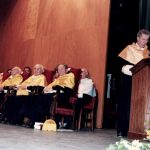
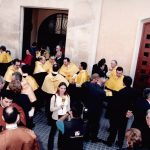
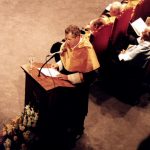
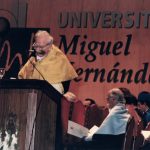
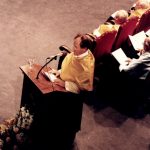
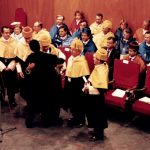
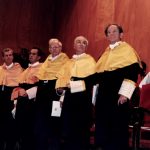
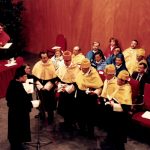
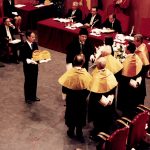
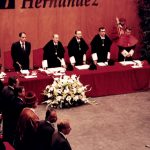
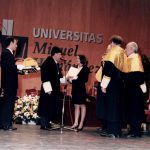
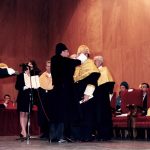
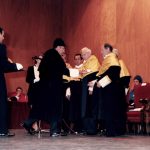
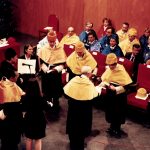
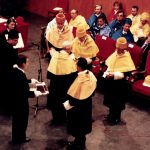
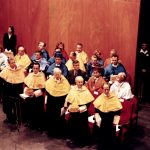
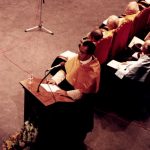
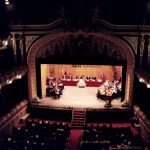
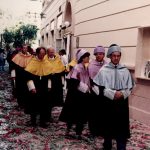
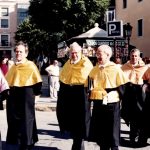
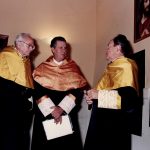
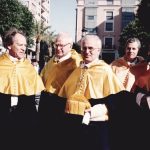
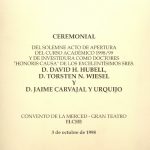
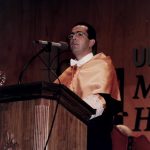
“Solemn Opening Ceremony of the 1998-99 Academic Year and investiture as Honorary Doctors of David H. Hubel, Torsten N. Wiesel and Jaime Carvajal y Urquijo” held on October 3, 1998 at the Gran Teatro de Elche.
Biografía
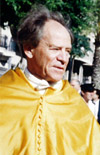
.jpg/440px-Nobel_Laureate_Torsten_Wiesel_in_2011_Photo_by_Markus_Marcetic_for_Young_Academy_of_Sweden_(cropped).jpg)
Nils Wiesel (Uppsala, Sweden, June 3, 1924) is a Swedish neurobiologist who won the Nobel Prize in Medicine in 1981.
Wiesel studied medicine at the Karolinska Institute in Stockholm, graduating in 1954. He began his teaching career at the same institute, later moving to the United States where he taught Physiology at Harvard Medical School and Johns Hopkins University. In 1983, he moved to Rockefeller University in New York, where he served as president from 1992.
Wiesel was awarded the Nobel Prize in Physiology or Medicine in 1981 for his contributions to the study of the visual cortex. He shared this honor with Canadian David Hubter Hubel and American Roger Wolcott Sperry.
Career
Wiesel was the youngest of five children. In 1947, he began his scientific career in the laboratory of Carl Gustaf Bernhard at the Karolinska Institute, where he received his medical degree in 1954. He then went on to teach in the physiology department of the Institute and worked in the child psychiatry unit of the Karolinska Hospital. In 1955, he moved to the United States to work at Johns Hopkins School of Medicine with Stephen Kuffler. Wiesel began a fellowship in ophthalmology and in 1958 became an assistant professor. That same year, he met David Hubel, beginning a collaboration that would last more than twenty years. In 1959, Wiesel and Hubel moved to Harvard University. He became an instructor of pharmacology at Harvard Medical School, beginning a 24-year career at the university. He became a professor in the newly formed neurobiology department in 1968 and its chair in 1971. In 1983, Wiesel joined the faculty of Rockefeller University as the Vincent and Brooke Astor Professor and director of the Laboratory of Neurobiology. He served as president of the university from 1991 to 1998. At Rockefeller University, he continues to be the director of the Shelby White and Leon Levy Center for Mind, Brain and Behavior. From 2000 to 2009, Wiesel served as Secretary General of the Human Frontier Science Program, an organization based in Strasbourg, France, that supports international and interdisciplinary collaboration among life sciences researchers. Wiesel has also chaired the scientific advisory board of the National Institute of Biological Sciences of China (NIBS) [16] in Beijing, and co-chairs the board of governors of the Okinawa Institute of Science and Technology (OIST). He is also a member of the boards of trustees of the Pew Center on Global Climate Change, the Hospital for Special Surgery, and a member of the advisory board of the European Brain Research Institute (EBRI). Wiesel has also served as chairman of the board of the Aaron Diamond AIDS Research Center (1995–2001), president of the Society for Neuroscience (1978–1979), and of the International Brain Research Organization (1998–2004). He was chairman of the board of governors of the New York Academy of Sciences (2001–2006) and was president and interim director of the academy in 2001–2002. Wiesel serves on the President’s Council of the People’s University and is a member of the Health Advisory Council.
Research
Hubel and Wiesel’s experiments greatly expanded scientific understanding of sensory processing. In one experiment, conducted in 1959, they inserted a microelectrode into the primary visual cortex of an anesthetized cat. They then projected patterns of light and dark onto a screen in front of the cat. They discovered that some neurons fired rapidly when presented with lines at one angle, while others responded better to a different angle. They called these neurons “simple cells.” Other neurons, which they termed “complex cells,” responded better to lines at a certain angle moving in a particular direction. These studies showed how the visual system constructs an image from simple stimuli into more complex representations. [20] Hubel and Wiesel were awarded the Nobel Prize in 1981 for their work on ocular dominance columns in the 1960s and 1970s. By depriving kittens of the use of one eye, they showed that columns in the primary visual cortex that receive input from the other eye take over the areas that would normally receive information from the deprived eye. These kittens also failed to develop areas that received information from both eyes, a feature necessary for binocular vision. Hubel and Wiesel’s experiments demonstrated that ocular dominance develops irreversibly early in childhood development. These studies opened the door to the understanding and treatment of childhood cataracts and strabismus. They were also important in the study of cortical plasticity.
Awards and Honors
Wiesel is a member of the Royal Swedish Academy of Sciences, the Serbian Academy of Sciences and Arts, and a foreign member of the National Academy of Sciences of India. He also holds the following awards and honors:
- Honorary degree from the University of Pavia in 2006.
- Order of the Rising Sun, Grand Cordon, 2009 (Japan). Honorary Doctorate of Science, University of Cambodia, 2010
- Nobel Prize in Physiology or Medicine, 1981
- Louise Gross Horwitz Prize, Columbia University, 1978
- Dr. Jules C. Stein Prize, 1971
- Ferrier Medal and Royal Society Lecture, 1971
- Lewis S. Rosenstiel Prize, 1972
- Freidenwald Prize, 1975
- Karl Spencer Lashley Prize, 1977
- Ledlie Prize, 1980
- Elected a Foreign Member of the Royal Society (ForMemRS), 1982
- W.H. Helmerich III Prize, 1989
- Ralph W. Gerard Prize in Neuroscience, 1993
- Helen Keller Prize for Vision Research, 1996
- Presidential Prize, 1998
- David Rall Medal 2005
- National Medal of Science in 2005 (USA).
Marshall M. Parks MD Medal of Excellence in 2007
In 2001, Wiesel was nominated for a position on an advisory panel of the National Institutes of Health to advise on research assistance in developing countries. Republican Tommy Thompson, who was then Secretary of Health and Human Services, rejected Wiesel. In addition to Wiesel, Thompson’s office rejected 18 other nominations (out of 26) and instead recommended other scientists whom whistleblower Gerald Keusch described in an interview as “lightweights” without “scientific credibility.” When Wiesel’s name was rejected, an official in Thompson’s office told Keusch that Wiesel had “signed too many full-page letters in The New York Times critical of President Bush.” This incident was cited by the advocacy group Union of Concerned Scientists as part of a report detailing its allegations of science abuse under the administration of President George W. Bush.
Personal life
Wiesel is married to Lizette Mususa Reyes (m. 2008). Wiesel was previously married to Teeri Stenhammar from 1956 to 1970, Ann Yee from 1973 to 1981, and author and editor Jean Stein from 1995 to 2007. His daughter Sara Elisabeth was born in 1975.
Human Rights
Wiesel has worked extensively as a human rights advocate worldwide. He served for 10 years (1994–2004) as chair of the Human Rights Committee of the U.S. National Academies of Sciences, as well as of the International Network of Academies and Scholarly Societies for Human Rights. He was awarded the David Rall Medal by the Institute of Medicine in 2005 in recognition of this important work. In 2009, Wiesel received the Grand Cordon of the Order of the Rising Sun in Japan.
He is a founding member of the Israeli-Palestinian Scientific Organization, a non-profit, non-governmental organization established in 2004 to support collaborative research between scientists in Israel and Palestine.