Miguel Hernández
13 February 2026
Miguel Hernández
Awarded an honorary doctorate posthumously by the Miguel Hernández University of Elche on October 18, 1998.
The fig tree planted in the honorary doctorate garden was taken from Miguel Hernández’s own fig tree.
Biography:
(Orihuela, 1910 – Alicante, 1942) Spanish poet. A member of the Generation of ’27, Miguel Hernández was known for the depth and authenticity of his verses, a reflection of his social and political commitment. Born into a humble family and raised in the rural environment of Orihuela, he worked as a goatherd as a child and had access only to very basic education, making his learning largely self-taught.
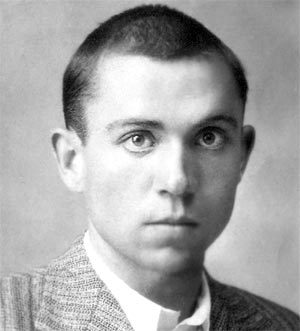 Photograph: Miguel Hernández at age 23
His interest in literature led him to delve into the works of classic poets such as Garcilaso de la Vega, Luis de Góngora, and Calderón de la Barca, who later had a marked influence on his verses (especially those of his youth) and his early theatrical endeavors. He also became acquainted with the works of authors like Rubén Darío and Antonio Machado. He participated in the local literary gatherings organized by his friend Ramón Sijé, meetings where he met Josefina Manresa, who would later become his wife and the inspiration for many of his poems.
At the age of twenty-four, he traveled to Madrid and met Vicente Aleixandre and Pablo Neruda; with the latter, he founded the magazine Caballo Verde para la Poesía (Green Horse for Poetry). The Marxist ideas of the Chilean poet had a profound influence on the young Miguel, who distanced himself from Catholicism and began the ideological evolution that would lead him to take a militant stance during the Spanish Civil War (1936-1939).
With the victory of the Popular Front, he collaborated with other intellectuals in the Pedagogical Missions, a social and cultural movement. After the outbreak of the Civil War (July 1936), he enlisted as a volunteer in the Republican army. During the conflict, he married Josefina Manresa, published several poems in the magazines *El Mono Azul*, *Hora de España*, and *Nueva Cultura*, and gave numerous recitals at the front. The death of his first son (1938) and the birth of his second (1939) further inspired his poetic work.
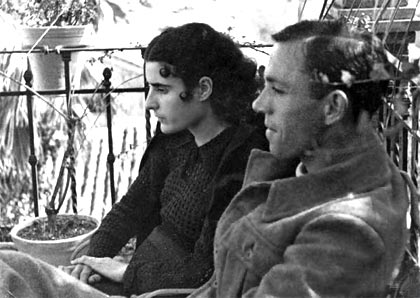 Photograph: With Josefina Manresa (Jaén, 1937)
After the war, he returned to Orihuela, where he was arrested. Sentenced to death, his sentence was later commuted to life imprisonment. After being held in several prisons, he died in the Alicante prison from tuberculosis; thus, one of the most promising careers in 20th-century Spanish literature was cut short.
The Poetry of Miguel Hernández
Although chronologically the author should belong to the so-called Generation of ’35, which included poets such as Luis Rosales and Leopoldo Panero, the style of his work and his relationship with the representatives of the Generation of ’27 lead him to be considered the youngest member of the latter or the “brilliant epigone of the group,” in the words of Dámaso Alonso. His writing career began with contributions to the Catholic-leaning magazine *El Gallo Crisis*, edited by Ramón Sijé.
His first volume of poetry, *Perito en lunas* (1934), consists of 42 octaves in which everyday, humble objects are described with a formal hermeticism that clearly reflects the influence of Góngora. However, in other poems from the same period, a greater verbal fluency and the beginning of his commitment to the cause of the dispossessed are evident.
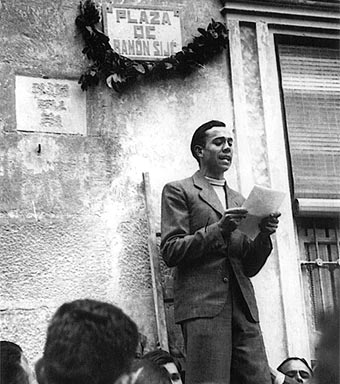
Photograph: At a tribute to Ramón Sijé (Orihuela, 1936)
In 1934, after publishing his religious play, *Quién te ha visto y quién te ve y sombra de lo que eras* (Who Has Seen You and Who Sees You Now, and Shadow of What You Were), in the style of Calderón, in the magazine *Cruz y Raya*, he began what would later be considered his masterpiece and mature work, *El rayo que no cesa* (The Unceasing Lightning) (1936), which he initially intended to title *El silbo vulnerado* (The Wounded Whistle). Life, death, and love (the latter serving as the guiding thread of the collection) are the central themes of a book composed mainly of sonnets and dazzling as a whole, although the elegy dedicated to the death of Ramón Sijé, written in terza rima and considered one of the most important in Spanish lyric poetry of all time, stands out.
During the Civil War, he cultivated what is known as war poetry: his republican faith was expressed in a series of poems collected in *Viento del pueblo* (1937), which included “Canción del esposo soldado” (Song of the Soldier Husband), addressed to his wife, and other famous works, such as “El niño yuntero” (The Young Ploughman). Also belonging to this period are the poetry collection *El hombre acecha* (1939), which reveals his tragic vision of the fratricidal conflict, and several dramatic texts published under the title *Teatro en la guerra* (1937).
While imprisoned, he wrote *Cancionero y romancero de ausencias* (1938-1941), where he used traditional forms of Castilian folk poetry to express, in a concise and simple style, his deep sorrow at being separated from his wife and children and the anguish caused by the devastating effects of the war.
Source: Fernández, Tomás and Tamaro, Elena. “Biography of Miguel Hernández.” In Biographies and Lives. The online biographical encyclopedia [Internet]. Barcelona, Spain, 2004.